


Wrinkle Smoothing & Facial Rejuvenation Treatments
Our experienced aesthetic team at the Hilger Face Center offers a full range of minimally invasive injectable treatments in a comfortable, professional setting in Minneapolis, MN. Whether you're looking to restore lost facial volume, soften deep lines, or smooth dynamic wrinkles caused by muscle movement, we offer personalized solutions tailored to your unique anatomy and aesthetic goals.
Understanding Injectable Treatments: Fillers vs. Neuromodulators
Not all injectable treatments work the same way — and understanding the difference is key to setting realistic expectations and achieving the best possible results.
There are two primary categories of cosmetic injectables:
Dermal Fillers add volume beneath the skin to smooth wrinkles, restore facial contours, and address the structural changes that come with aging — including volume loss in the cheeks, temples, lips, and under-eye area.
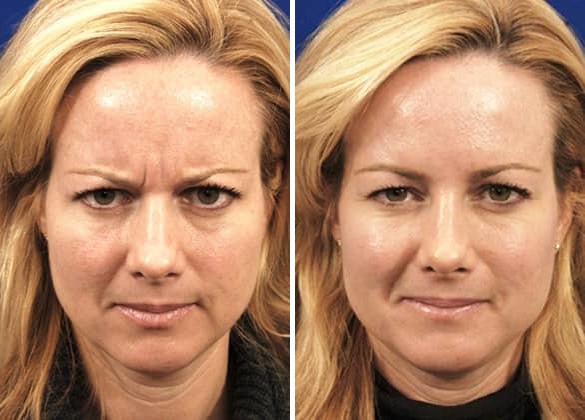
Neuromodulators (such as Botox® and Xeomin®) work by temporarily relaxing the facial muscles responsible for repetitive expressions — like squinting, frowning, or raising the eyebrows. Over time, these repeated muscle contractions create "dynamic wrinkles," such as crow's feet, forehead lines, and the "11 lines" between the brows. Neuromodulators interrupt that cycle, allowing the skin to smooth out.
Many patients achieve optimal results by combining both treatment types, as they address different underlying causes of facial aging.
Dermal Fillers: Restoring Volume and Contour
As we age, the face naturally loses fat, collagen, and bone density. This can result in hollowing under the eyes, flattening of the cheeks, deepening of the nasolabial folds (the lines from your nose to the corners of your mouth), and thinning of the lips. Dermal fillers are injected directly into targeted areas to replenish this lost volume and smooth the skin from beneath.
At the Hilger Face Center, we offer a carefully curated selection of FDA-approved filler products. Common filler families include:
- Hyaluronic acid (HA) fillers — such as the Juvederm® and Restylane® product lines — attract and retain moisture, making them ideal for lips, cheeks, and under-eye hollows. HA fillers are also reversible, which offers an added layer of reassurance for new patients.
- Calcium hydroxylapatite fillers — such as Radiesse® — provide a firmer correction and can stimulate collagen production, making them well-suited for deeper facial folds and hand rejuvenation.
- Poly-L-lactic acid fillers — such as Sculptra® — work gradually to stimulate your body's own collagen, producing subtle, long-lasting improvements in facial volume over a series of treatments.
Our surgeons will recommend the most appropriate filler type and formulation based on your specific anatomy, treatment area, and desired outcome.
Neuromodulators: Botox® and Xeomin®
Botox® and Xeomin® are FDA-approved neuromodulators derived from botulinum toxin type A. While they share the same mechanism of action — temporarily reducing muscle activity to relax dynamic wrinkles — there are subtle differences in formulation, onset time, and diffusion patterns that may make one product a better fit for certain patients or treatment areas.
- Botox® is the most widely recognized and longest-studied neuromodulator, with a well-established safety record. It is commonly used for forehead lines, crow's feet, and glabellar lines (the "11s").
- Xeomin® is formulated without accessory proteins, which some providers prefer for patients who may have developed resistance to other neuromodulators over time.
Both are temporary treatments, with results typically lasting three to four months, though individual results vary. With consistent treatment, many patients find that results gradually last longer as the targeted muscles become less active over time.
Combining Fillers and Neuromodulators
For patients experiencing both volume loss and dynamic wrinkle activity, combining dermal fillers with a neuromodulator often produces the most natural-looking, comprehensive rejuvenation. This approach allows us to address multiple dimensions of facial aging in a single appointment.
For example, a patient might receive Botox® to relax forehead lines while a hyaluronic acid filler is used to restore volume to the cheeks and soften the nasolabial folds. By treating both muscle-driven and volume-related concerns together, results are more balanced and longer-lasting than either treatment could achieve alone.
All injectable treatments at the Hilger Face Center are performed on an outpatient basis in our Minneapolis office. Most appointments can be completed in under an hour, with minimal downtime.
What to Expect at Your Appointment
During your initial consultation, a member of our aesthetic team will review your concerns, evaluate your facial anatomy, and discuss your goals. We take a personalized approach since no two patients are the same, and we don't believe in one-size-fits-all treatment protocols.
If you proceed with treatment, most injectable appointments involve:
- A thorough review of your medical history and any relevant medications
- Discussion and mapping of injection sites
- Optional topical numbing to maximize comfort
- The injections themselves, which typically take 15–45 minutes depending on the number of areas treated
- Post-treatment guidance and follow-up scheduling
Results from neuromodulators typically appear within 3–7 days and peak around two weeks post-treatment. Filler results are visible immediately, with final results settling after any initial swelling resolves, usually within one to two weeks.
Schedule a Consultation at Hilger Face Center
If you're considering dermal fillers, Botox®, or a combination approach, we invite you to schedule a consultation at the Hilger Face Center in Minneapolis, MN. Our experienced facial plastic surgeons and skilled aesthetic team are here to help you look and feel your best.

Meet Samantha, RN, the Aesthetic Nurse Injector at the Hilger Face Center!
Samantha brings a wealth of experience in aesthetics and is passionate about enhancing our patients' natural beauty.
-
What are Injectable Fillers?
-
Am I a Candidate for Injectable Fillers?
-
Where is the Procedure Performed?
-
How Long Does an Injection Take?
-
Is Anesthesia Used?
-
What Happens During an Injection?
-
When Can I Go Back To Work?
-
When Can I Exercise Again?
-
What Results Can I Expect?
-
What About Permanent Fillers?
-
Are There Risks?
Injectable fillers are used to add volume to the facial area and to fill in wrinkles. The material used in the fillers, where they work, and how long they last vary from product to product and brand to brand.
Although they are both a type of injection, don’t confuse fillers with treatments such as Botox®, Dysport or Xeomin. Injectables containing botulinum toxin work on different types of wrinkles than fillers.
A candidate for an injectable filler is a person with fine or deep wrinkles created by the effects of gravity or by a loss of volume in the face. Our team at the Hilger Face Center will discuss your specific aging concerns with you during a consultation to help you determine which filler or combination of fillers will best meet your needs.
Injectable fillers are administered right in our Hilger Face Center clinic. There is no need to visit a surgical center or hospital.
It depends on the size of the area being treated and the number of injections you’re receiving. Some patients are in and out of the office in just 15 or 20 minutes. In other cases, it might take a full 45 minutes for the treatment.
Many fillers contain a local anesthetic, such as lidocaine, to increase patient’s comfort. In addition to that, the surgeons at the Hilger Face Center also use a topical anesthetic to further improve comfort. Some patients might also receive a nerve block, but that is only given in very rare cases.
Before an injection, your care team will mark the areas that will be filled in and will give you a hand mirror to review the locations. Next, you’ll sit in a comfortable lounge chair while the surgeon uses microcannulas or very fine needles to inject your chosen filler into the areas.
Little recovery or downtime is needed after a minimally invasive filler or injection treatment. You might be ready to go back to work right after your treatment. At the latest, you should be able to return to your job the next day.
You can resume all your usual activities, including exercise, almost right away after your filler or injection.
It will depend in large part on the type of filler you received and where it was injected. For the most part, results from injectable fillers last for at least six months to a year, if not longer. Usually, the results appear right away, except in the case of Sculptra and Botox®. Botox® and similar injections provide results that last for about three months and the medication takes 3 to 7 day to work maximally.
The surgeons at the Hilger Face Center avoid permanent filler. Although the concept of a permanent correction is attractive, the current permanent fillers available on the market raise some concern. There is a small but measurable incidence of persistent lumpiness and bumpiness with the use of these fillers, and because the products are represented by microscopic particles they cannot be removed. Therefore we avoid the use of such fillers at this time. Hopefully in the future a more persisting filler with a safer profile will be available.
Although there are some risks associated with injectable fillers and non-invasive cosmetic treatments, the likelihood of risks occurring when the treatments are performed by trained surgeons is very, very low.
One of the more common complaints, affecting about 5 percent of patients, is that there isn’t enough filler in one area. If that is the case, you can return for a touch-up appointment. If you decide you are not happy with your results, it’s possible to dissolve certain types of fillers and reverse the results.